

Senior Care Navigation Calgary: Your Authoritative Guide for Families Facing Aging Parent Decisions
SENIOR CARE NAVIGATION CALGARY • CONTINUING CARE ALBERTA • HOUSING AND SUPPORT OPTIONS
A CLEAR STARTING POINT FOR SENIOR CARE DECISIONS IN CALGARY
Families in Calgary are facing a new reality. Parents and spouses are living longer, often with complex health conditions, and the maze of Alberta Health Services (AHS) programs, continuing care options, and private senior living can feel overwhelming.
Last updated: • Location: Calgary, Alberta
You might recognize your own situation in one or more of these:
- A parent has started falling more often or seems unsteady on the stairs.
- Medications are piling up and it is not clear what is being taken correctly.
- One spouse is now a full time caregiver and is visibly exhausted.
- You hear terms like “continuing care”, “funded bed”, “designated supportive living”, and “memory care” and you are not sure how they relate to each other.
In Calgary, senior care decisions involve health, housing, and support systems together. That is why many families now look for senior care navigation rather than trying to do this alone.
At CarePatrol Calgary, we help families navigate health, housing, and support decisions for aging loved ones, so they get the right help at the right time. Our guidance is local and free for families.
Quick takeaway: Senior care decisions in Calgary often involve multiple systems at once. This pillar breaks the process into clear steps, explains funded vs private pathways, and shows how CarePatrol Calgary supports families with local, no-fee guidance.
Why Calgary Senior Care Decisions Feel So Complicated
Calgary families are not imagining it. There are several systems overlapping.
- AHS Home Care offers professional support in the home, but visits are limited in time and scope.
- Continuing Care in Alberta includes different levels of publicly funded facility based care, such as long term care and designated supportive living.
- Private senior living communities offer independent living, assisted living, and memory care at full private rates, often 4,000 dollars or more per month.
- There are also short stay, respite, and day program options, each with different eligibility rules.
On top of the services, there are practical questions.
- Who decides when a person qualifies for a funded continuing care home.
- How regulated accommodation fees compare to full market rent.
- When independent or assisted living in Calgary is a better fit than waiting for a funded space.
- How to balance the older adult’s wishes with safety and caregiver burnout.
Senior care navigation exists because most families do not have time to become experts in all of this. They need someone who already understands the Calgary landscape and can apply it to their situation.
What Senior Care Navigation Is and How CarePatrol Calgary Helps

Senior care navigation is professional guidance that helps families understand, plan, and make decisions about care, housing, and support for an aging loved one.
In Calgary, senior care decisions often involve multiple systems at once, including Alberta Health Services (AHS), private home care, senior housing, and community supports. Families may feel pressure to act quickly while also trying to balance safety, independence, finances, and caregiver stress.
CarePatrol Calgary provides local senior care navigation through a set of connected services, designed to support families at different stages of the aging and care journey. Some families need clarity and planning before making any changes. Others are already facing urgent housing or dementia-related decisions. Our services are structured so families can access the level of support that fits their situation.
CarePatrol Calgary offers four core services:
- Senior Care Navigation & Calgary Aging Plan, which combines a guided navigation conversation with a written plan
- Senior Housing & Support Match, focused on identifying and comparing appropriate living and support options
- Dementia Care Navigation, providing specialized guidance for families living with Alzheimer’s disease or other dementias
- Legal, Financial & Move Support Network, connecting families with trusted local professionals when additional support is needed
Each of these services is explained in detail below, so families can understand how they work and when each one may be helpful.
Service 1: Senior Care Navigation & Calgary Aging Plan

This is the most common starting point for families in Calgary. It is designed to turn “We don’t know what to do” into a clear plan you can act on. We begin with a structured navigation conversation to understand what is happening day to day, then we build a written Calgary Aging Plan so the family has a shared reference point and next steps.
When families usually book this service
- Something has changed at home and everyone is worried.
- A doctor, social worker, or lawyer has hinted that it may be time to plan senior care.
- A family member keeps saying “We should look into assisted living in Calgary” but no one has the energy to start.
- The main caregiver is running on fumes, especially if nights are disrupted.
What happens in the navigation conversation
- We listen to what has been happening day to day.
- We ask questions about mobility, falls, memory, mood, sleep, and daily routines.
- We explore caregiver stress, family dynamics, and money concerns in a practical way.
- We explain how AHS funded services, Home Care, and Continuing Care placement typically work in Alberta.
- We outline realistic next steps that fit your situation and your capacity.
The conversation can happen by phone or video. Afterward, families receive a written plan, so there is a shared reference point rather than relying on memory.
Typical Senior Care Navigation conversation flow
| Session step | What we do | Expected outcome and time |
|---|---|---|
| Intake and goals | We listen and clarify what changed, who the decision makers are, and what matters most. | Clear focus; about 10 to 15 minutes. |
| Clinical snapshot | We review medications, mobility, cognition, and recent events to identify risks. | Immediate risk clarity; about 15 to 25 minutes. |
| Options mapping | We map local care pathways and funding realities in Calgary. | Prioritized choices and trade offs; about 10 to 20 minutes. |
| Action plan | We outline next steps, referrals, and timing. | Concrete next steps and contacts; about 5 to 15 minutes. |
What families receive in the written Calgary Aging Plan
The written plan is designed to be practical. It helps families move forward without guessing, and it gives siblings and professionals a shared picture of the situation.
Calgary Aging and Care Plan: core elements
| Plan element | What it includes | Why it matters |
|---|---|---|
| Clinical and safety snapshot | Health concerns, falls, cognition, medication risks, and daily safety issues. | Guides which services and housing levels make sense. |
| Preferences and values | Location in Calgary, routines, cultural and spiritual needs, family priorities. | Keeps decisions aligned with what matters most. |
| Financial and benefits overview | Budget guardrails, affordability realities, and benefit considerations. | Ensures recommendations are sustainable and realistic. |
| Housing and support roadmap | Home supports, funded pathways, private options, and next steps over 6 to 18 months. | Creates a path instead of reacting to every change as a crisis. |
| Key contacts and referrals | Trusted partners when needed (elder law, home care, move support, financial guidance). | Makes it easier to act quickly when you are ready. |
| Triggers and review points | Signs to watch for and when to update the plan. | Helps you know when it is time for the next decision. |
Cost to families: no fee. CarePatrol Calgary is paid by participating senior living communities when an appropriate match leads to a move, so planning support remains free for families.
Service 2: Senior Housing and Support Match

When the time comes to look at specific senior housing and support options in Calgary, families often feel pressure to make fast decisions on limited information. Online searches can turn up dozens of options with very different price points and levels of care. Housing and Support Match is designed to cut through that noise and focus only on what truly fits.
The Senior Housing and Support Match uses what we have already learned about your situation and applies it directly to the local market.
What Senior Housing and Support Match includes
- Matching care needs and preferences to levels of housing: independent, assisted, memory care, or continuing care homes.
- Identifying communities and services in Calgary and surrounding areas that fit needs and budget.
- Providing a curated shortlist with clear reasons for each recommendation.
- Coordinating tours or meetings with communities when the family is ready.
- Preparing you with questions about staffing, safety, activities, and how care changes are handled.
- Debriefing after each tour so impressions and concerns are captured while fresh.
CarePatrol Calgary is compensated by participating senior living communities when a family we are working with moves into one of their qualifying suites. This allows our guidance to remain free for families.
Calgary senior housing types at a glance
| Housing type | Level of care or support | Typical features and best for |
|---|---|---|
| Independent living | Low to none | Private apartments and social activities, best for active seniors needing minimal daily help. |
| Assisted living | Moderate | Personal care assistance and medication support, ideal for seniors needing help with daily activities. |
| Memory care or specialized care | Focused dementia support | Structured routines and secure environment, for people with moderate to advanced cognitive impairment. |
| Long term care | High clinical support | Twenty four hour nursing care, for complex medical needs and higher dependency. |
| Home care (in home services) | Variable | Personal care and nursing visits at home, best when staying at home is preferred and feasible. |
For a deeper look at housing, you can also read our Guide to Retirement Homes in Calgary, which explains what to look for and how to compare communities.
Service 3: Dementia Care Navigation

Caring for someone with Alzheimer’s disease or another dementia is different from caring for someone who is physically frail but thinking clearly. Memory loss, changes in judgment, and shifts in personality can turn everyday tasks into safety questions. Families often carry grief, frustration, and exhaustion at the same time.
Dementia Care Navigation is a focused layer of support that can sit on top of any of the other services we provide. It is for families who are starting to see changes, or who are already in the thick of it and feel they are reacting to one crisis after another.
What Dementia Care Navigation looks at
- Safety and supervision needs: wandering risk, night time confusion, exit seeking, kitchen risks, getting lost, and how often someone must be physically present.
- Changes in behaviour and relationships: suspicion, anger, withdrawal, repeated calls, resistance to care, or behaviour that is frightening for others.
- Caregiver load and burnout: sleep, ability to leave the house, work and health impacts, and what support is realistic.
- Environment and housing fit: whether the home can be adapted, what AHS can realistically provide at home, and which Calgary communities are truly built and staffed for memory care.
- Planning ahead: what to expect as dementia progresses and how to time changes so they cause the least disruption.
From there, we help you decide what can be put in place now at home, what needs to change soon, and what a safer long term plan looks like.
Dementia Care Navigation focus areas
| Focus area | What we look for | How we respond |
|---|---|---|
| Safety and supervision | Wandering, night time confusion, leaving home unsafely. | Recommend safety measures, home adaptations, and when to consider secure settings. |
| Behaviour and mood | New suspicion, anger, withdrawal, or agitation. | Suggest medical review, community programs, and practical communication strategies. |
| Caregiver strain | Lack of sleep, feeling on duty all the time, health impacts. | Connect to respite, home supports, and caregiver resources. |
| Environment and housing | Fit of current home, layout, triggers, community capability. | Compare staying at home with memory capable housing in Calgary. |
| Future planning | Likely progression, risk of future crises. | Map staged supports and timing for possible moves. |
The aim is to help families move from constant firefighting to a more predictable, safer path, with housing and supports that understand dementia.
Service 4: Legal, Financial & Move Support Network
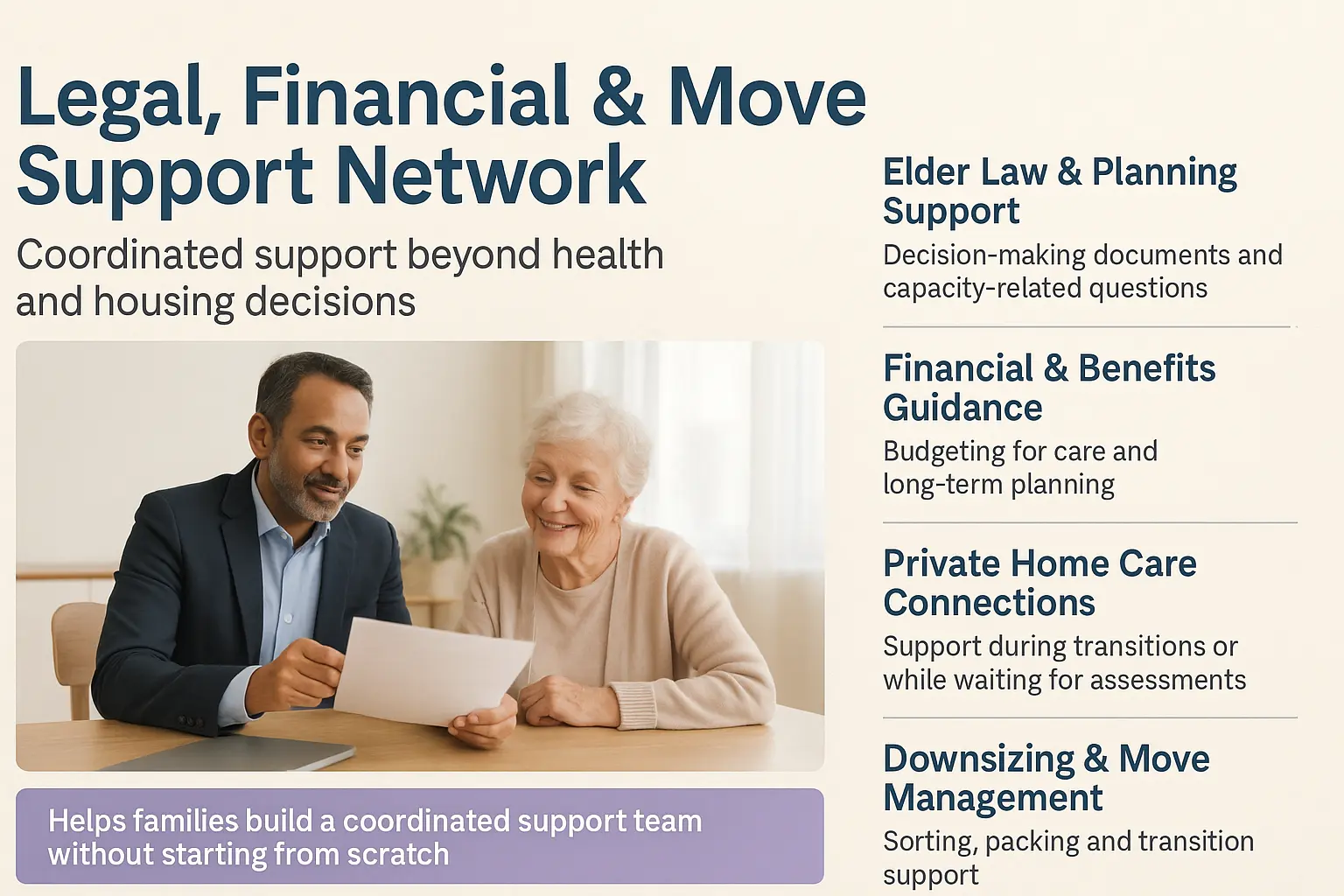
Some families need more than health and housing guidance. They also need support with planning documents, budgeting for care, coordinating private help, or managing a move. We do not provide legal or financial advice, but we can connect families with trusted local professionals when it makes sense.
Common support areas families ask for
- Elder law and estate planning: questions about decision-making, powers of attorney, capacity concerns, and planning documents.
- Financial and benefits guidance: budgeting for care, understanding benefits, and planning for longer term affordability.
- Private home care options: when families need support quickly, or while waiting for assessments or placements.
- Downsizing and move-management: sorting, packing, transition planning, and practical move support.
These connections are meant to reduce delays and help families build a coordinated support team, especially when decisions are time sensitive.
CarePatrol Calgary services at a glance
| Service | Who it helps and what you receive |
|---|---|
| Senior Care Navigation & Calgary Aging Plan |
|
| Senior Housing & Support Match |
|
| Dementia Care Navigation |
|
| Legal, Financial & Move Support Network |
|
AHS Funded vs Private Senior Care in Alberta
Many Calgary families are surprised to learn that funded continuing care in Alberta is based on care needs, not income. It is easy to assume there is a financial test, but the primary gate is clinical.
In simple terms:
- AHS assesses a person’s care needs using standardized tools and clinical judgment.
- If needs are high enough, a person may be approved for a place in a continuing care home.
- AHS pays for the health and personal care portion in a funded continuing care home.
- The resident still pays a regulated accommodation fee for room and board.
- People whose needs are not high enough, or who prefer different locations or environments, often look to private options.
AHS funded vs private care: key comparison
| Option type | Eligibility, services, and access |
|---|---|
| AHS funded services |
|
| Private services |
|
| Blended approach |
|
Senior care navigation helps families decide how to balance these paths, especially when safety is changing faster than wait times.
When to Start Senior Care Planning in Calgary
Waiting for a crisis often narrows the available choices. Families who benefit most from senior care navigation usually reach out when they first notice:
- Increasing falls or near misses on stairs and in the bathroom.
- Confusion with medications, food, or bills.
- Changes in memory, mood, or behaviour that feel out of character.
- Social withdrawal, isolation, or reluctance to leave home.
- Caregivers beginning to sacrifice their own health, sleep, or employment.
Early signs it may be time to talk
| Sign | What you might notice | Why it matters |
|---|---|---|
| Falls and near misses | Trips on stairs, slips in the bathroom, unexplained bruises. | Indicates higher risk of serious injury. |
| Medication confusion | Missed doses, double dosing, mixed pill boxes. | Raises risk of hospital visits and may signal cognitive change. |
| Memory and mood changes | Repeating stories, irritability, withdrawal from activities. | Can affect safety, relationships, and quality of life. |
| Caregiver strain | Exhaustion, worry, trouble balancing work and care. | Risk of burnout and health issues for the caregiver. |
What to prepare before your first session
You do not need to be fully organized to reach out. It can help to have:
- A list of current diagnoses and medications, if available.
- Recent changes in mobility, memory, or daily routines.
- Falls, hospital visits, or major events in the last six to twelve months.
- Who is involved in care today and how they are coping.
- Any major financial constraints or non negotiable values, such as staying near a certain part of Calgary or keeping a couple together.
Why Local and Free Guidance from CarePatrol Calgary Matters
In a world of national websites and generic checklists, local knowledge still matters.
CarePatrol Calgary focuses on:
- Calgary and surrounding communities, not a broad national directory.
- Real time understanding of which senior living communities and services are appropriate for different situations.
- The realities of AHS Home Care and Continuing Care access in Alberta.
- The emotional and practical load families are carrying when they call.
Our guidance is free for families because our compensation comes from senior living communities when an appropriate match leads to a move. That structure allows us to spend meaningful time helping families plan, without adding to their financial stress.
Next Steps: Taking the First Move Toward Clarity
Senior care decisions in Calgary do not have to be made in a fog.
At CarePatrol Calgary, we help families navigate health, housing, and support decisions for aging loved ones, so they get the right help at the right time. Our services include the Senior Care Navigation & Calgary Aging Plan, the Senior Housing and Support Match, Dementia Care Navigation, and connections to trusted legal, financial, and move-support professionals.
If you recognize your family in any of the situations described here, consider reaching out for a conversation. There is no fee and no obligation. You gain clearer information, a local perspective, and a partner in the planning process.
You do not have to carry all of this on your own.
Want a clear plan for the next step?
Reach out for a conversation. There is no fee and no obligation.