When AHS Home Care Is Not Enough: What Calgary Families Can Do Next
|
ALBERTA • CALGARY • AHS HOME CARE • PRIVATE HOME CARE • SUPPORTIVE LIVING • MEMORY CARE
When AHS Home Care Is Not Enough: What Calgary Families Can Do Next
|
Table of Contents |
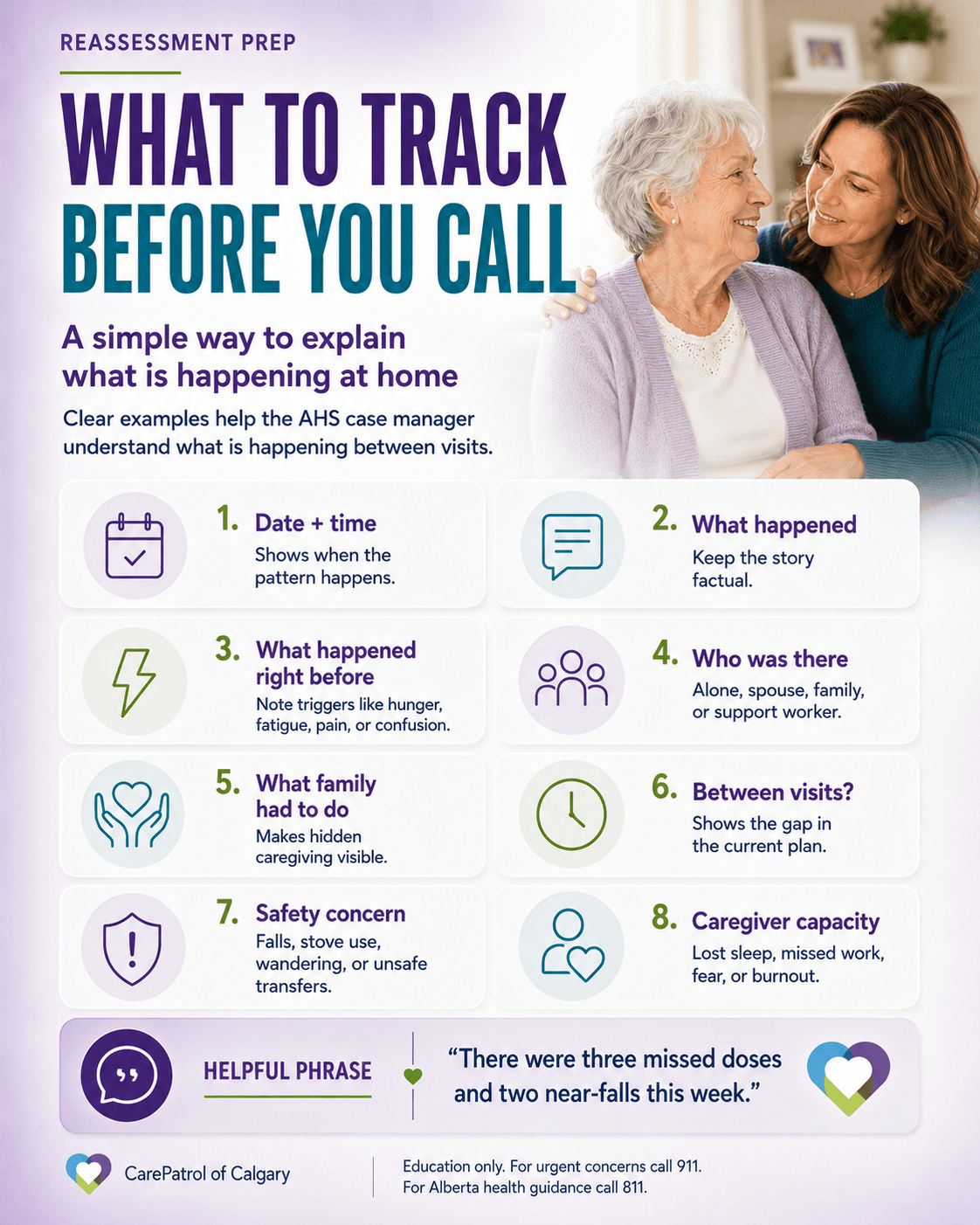
Short AnswerIf AHS home care is coming in but your loved one still feels unsafe at home, start by writing down what is happening between visits. Track the actual incidents: falls, near-falls, missed medication, evening confusion, unsafe transfers, food that is not being eaten, hygiene changes, repeated calls, wandering, stove concerns, or one caregiver carrying the whole plan. Then contact the AHS case manager or ask about a care plan review or reassessment. Some families may need private home care to fill predictable gaps. Others may need to compare supportive living, memory care, or long-term care options if the risks are frequent, unpredictable, dementia-related, or mostly being carried by exhausted family members. AHS Home Care Is Coming In. So Why Does Home Still Feel Unsafe?AHS home care can be a real support for Calgary families trying to keep an older adult safe at home. But sometimes the visits are happening, the worker is helping, and the family still feels uneasy because the risky moments are happening outside the scheduled care. Nobody calls AHS home care because everything is going smoothly. Usually, something has already happened: a fall, a hospital stay, a shower that became difficult, a medication routine that stopped being reliable, or a family caregiver who has been trying to hold everything together for too long. When home care starts, it can bring real relief. The visit may help with personal care, nursing needs, respite, rehabilitation, equipment, or other assessed supports depending on the person’s situation. The harder part is what happens after the visit ends. Evening confusion may still happen. The stairs are still there. The pills may still be confusing. Food may be in the fridge but not eaten. A spouse may still be afraid to sleep because their partner gets up at night. One adult child may still be answering every call, filling every gap, and quietly becoming the backup system for the whole care plan. AHS home care can be helpful and still not be enough for the stage of the problem. The visit may be doing exactly what it is supposed to do, while the rest of the day is showing that the care needs have changed. The Signs Are Usually Small Before They Are ObviousFamilies often wait for one big event to prove that home is no longer working. Sometimes that event happens, such as a fall, a hospital visit, a wandering incident, a kitchen accident, or a medication mistake with serious consequences. More often, the warning signs show up in smaller ways. The pill organizer does not match the day. There is food in the fridge, but it is not being eaten. A parent says, “I’m fine,” while avoiding the stairs, skipping showers, or wearing the same clothes again. A neighbour mentions that Dad seemed confused outside. The stove gets left on once, and everyone hopes it was a one-time thing. Other signs are easier to explain away: a missed bill, a forgotten appointment, a near-fall that “doesn’t count” because nobody hit the floor, or more frequent phone calls from a parent who sounds worried but cannot quite explain what they need. At first, the family may absorb these gaps without calling them care needs. One person starts checking in every day, then after work, then on weekends, then whenever the phone rings. If the current plan only works because one person keeps catching everything between visits, it is time to look at what the plan is really depending on. Why More Home Care May or May Not Solve the ProblemMore home care can help when the need is predictable. If the older adult needs support with bathing, meals, medication reminders, companionship, transportation, respite, or a regular visit that gives the family some breathing room, adding more hours may make sense. Private care can also help when families need flexibility that scheduled public support may not provide, such as evening help, overnight support, longer visits, dementia-aware companionship, or help between AHS visits. But more hours do not solve every kind of risk. If the person needs supervision rather than task-based help, if dementia-related behaviour is escalating, if transfers are unsafe, if medication mistakes continue even with reminders, or if the situation falls apart whenever family is not there, the care need may be bigger than another visit. More hours can help, but they cannot turn an unsafe setup into a stable care plan by themselves. Before You Ask for Reassessment, Write Down What Is Actually Happening“Mom is worse” may be true, but it is vague. “Mom missed evening medication three times this week and had two near-falls after supper” gives everyone something clearer to work with. Before you call the case manager, doctor, private care provider, or senior living advisor, write down what is happening at home. You do not need a perfect report. A note on your phone is fine. The goal is to show the pattern.
A few examples are enough to start the conversation. You might write: “Dad called three times after supper saying he needed to go to work, even though he has been retired for years,” or “Mom’s Friday pill pack still had Tuesday evening pills inside,” or “My spouse says she is afraid to sleep because he gets up overnight.” Those details are harder to dismiss than a general feeling that things are getting worse. When to Contact the AHS Case Manager or Ask for ReassessmentIf your loved one already has AHS home care, the case manager is an important contact when care needs change. Ask about a care plan review or reassessment when there has been a clear change, such as new falls, medication mistakes, unsafe transfers, worsening dementia symptoms, wandering, increased evening confusion, major changes in eating or hygiene, a hospital stay, caregiver burnout, or family no longer being able to cover the gaps. Useful questions include:
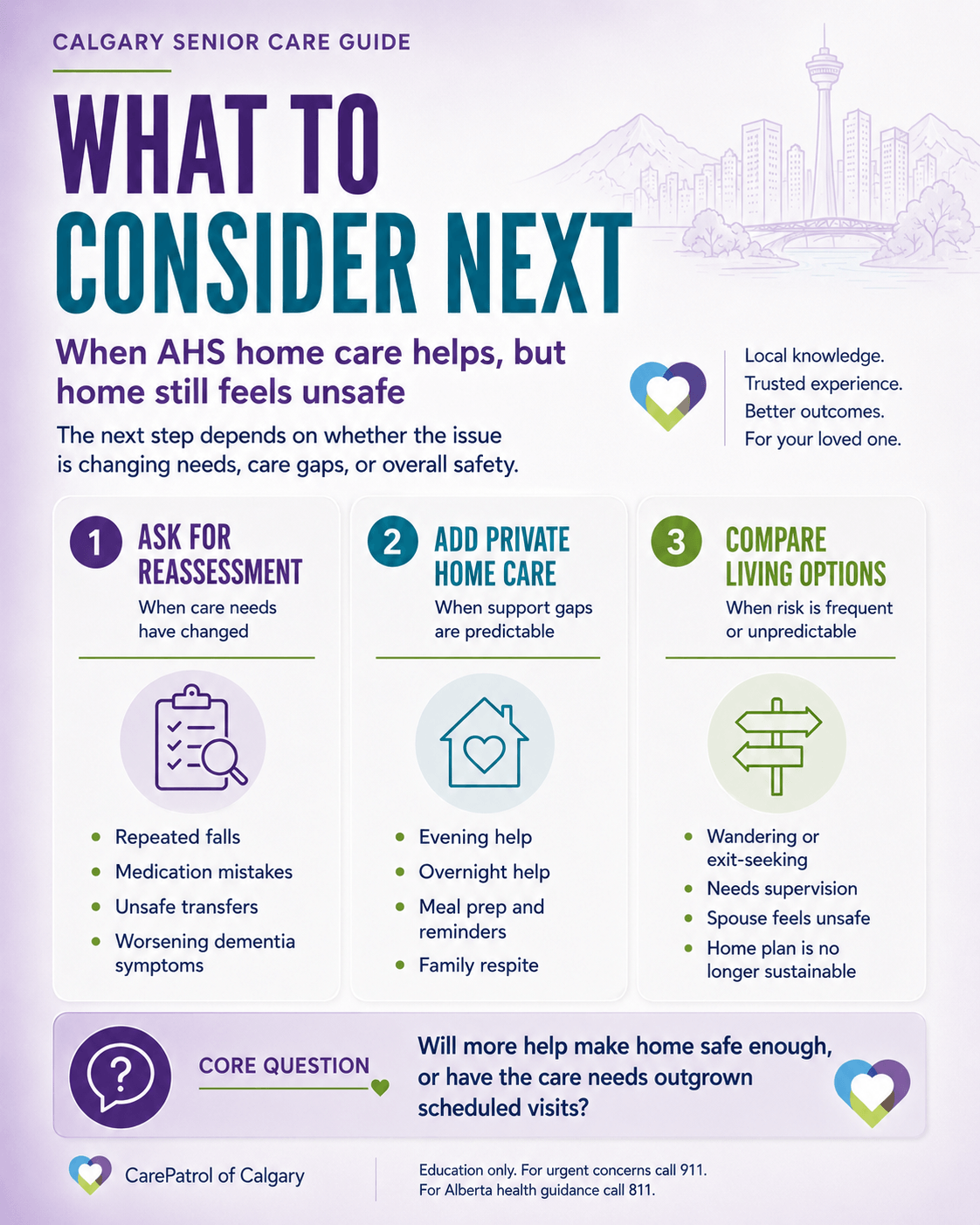
You do not need to explain it perfectly. Start with what happened. When Private Home Care Can Fill the GapPrivate home care may be useful when the current plan is close, but not quite enough. Families often look at private care for evening support, overnight help, transportation, companionship, meal preparation, cueing, respite, dementia-aware support, personal care, or help between AHS visits. This can buy time and reduce pressure. It can also make the situation clearer. Sometimes private care steadies things enough for home to keep working. Sometimes it shows that the person now needs more supervision than the home setting can realistically provide. The question is not only, “Can we add more help?” The better question is, “Will more help make this safe enough?” Those are not always the same question. When Home May No Longer Be the Safest SettingSometimes the conversation needs to move beyond home care because the person’s needs are bigger than scheduled visits and family patchwork can safely manage. In Alberta, continuing care language has changed under the Continuing Care Act. Families may hear older terms and newer terms at the same time, including home care, supportive living, continuing care homes, memory care, and long-term care. Supportive Living or Continuing Care Home Type BThis may become part of the conversation when someone needs more structured support, onsite care availability, help with daily routines, or a setting that can support care needs more consistently than home. Memory Care or Secure SupportThis may become part of the conversation when dementia-related safety concerns, wandering, exit-seeking, agitation, or supervision needs are becoming harder to manage at home. Long-Term Care or Continuing Care Home Type AThis may be discussed when someone has complex, unpredictable medical or personal care needs that require a higher level of onsite support. CarePatrol does not decide eligibility for publicly funded continuing care. AHS and the appropriate care teams are involved in assessment and access. What families can do is prepare better questions, understand what different settings do and do not provide, compare private-pay options when appropriate, and avoid touring places that cannot support the actual care needs. Sometimes the question is not, “Can we keep Dad at home?” With enough money, guilt, and one exhausted daughter, the answer might be yes for a while. The better question is, “Is this still safe, sustainable, and honest?” Calgary Decision Map: What to Consider Next
Common Calgary Family ScenariosIn Calgary, this question often comes up after a hospital stay, when the discharge plan gets someone home but evenings, medication, meals, or bathroom safety still feel uncertain. The family may be grateful for the support and still worried that one bad night could undo the plan. It also comes up when dementia is part of the picture. The visit may go well, but confusion builds later in the day. The person may become restless, call repeatedly, try to leave, or resist help because they do not understand why it is needed. Another common pattern is one adult child or spouse carrying more than anyone has named. AHS visits may be in place, but one person is still handling groceries, laundry, appointments, calls, medication concerns, and every “small” thing that happens between visits. Families also reach this point when private care costs are growing. A few hours become a few evenings, then weekends, then overnight support. At that stage, it can be useful to compare the cost, stress, and safety of staying home with other care options. How CarePatrol of Calgary Helps When Home Care Is No Longer the Whole AnswerCarePatrol does not replace AHS, decide eligibility, provide medical care, or tell families to ignore the case manager, doctor, hospital team, or home care provider. We help families sort through the options when the current plan is no longer enough. That may include understanding what kind of care may fit, comparing public and private pathways, preparing better questions for AHS or private providers, narrowing Calgary-area options, avoiding communities that cannot support the actual care needs, and thinking through costs, timing, and family capacity. If AHS home care is helping but the house still feels one bad weekend away from chaos, CarePatrol of Calgary can help you look at the next step based on what is actually happening at home, not what everyone hoped would be enough. FAQCan AHS home care be increased in Alberta?Sometimes a care plan can be reviewed if needs have changed. If your loved one has an AHS case manager, contact them and explain what has changed. Bring specific examples, especially if risks are happening between visits, overnight, or when family is not there.
What does AHS home care cover?Coverage depends on assessed needs. AHS home and community care may include supports such as nursing, personal care, medication-related support, respite, palliative care, wound care, equipment, rehabilitation, or living option assessments, depending on the person’s situation and assessment.
What if AHS home care is not enough?Document what is happening, especially between visits, overnight, or during dementia-related confusion. Then ask about a care plan review or reassessment. Depending on the situation, families may also need to consider private care, respite, supportive living, memory care, or long-term care.
Can private home care work with AHS home care?Many families use private care to add flexibility, hours, or support beyond what is included in the public care plan. The right approach depends on the person’s assessed needs, risks at home, budget, and family capacity. Confirm details with the AHS case manager and any private provider you are considering.
When should we consider senior living instead of more home care?Consider looking at senior living or continuing care options when risks are frequent, unpredictable, overnight, dementia-related, or mostly being carried by exhausted family members. Also look closer when falls, medication mistakes, wandering, unsafe transfers, poor nutrition, or caregiver burnout are becoming regular parts of the week.
Should we call 811 or 911?For urgent or life-threatening concerns, call 911 or go to the nearest emergency department. For health advice and system navigation in Alberta, Health Link is available by calling 811.
Sources and Helpful Alberta ResourcesThis article was prepared using practical senior care experience, family transition patterns, and publicly available Alberta health and continuing care resources. It is educational and should not replace medical, legal, or clinical advice. |
ABOUT THE AUTHOR Certified Professional Consultant on Aging (CPCA)® and Values Based Care Specialist Shar supports Calgary families comparing home care, assisted living, memory care, supportive living, retirement living, and continuing care options. CREDENTIALS
Certified Professional Consultant on Aging (CPCA®) 
Values Based Care Specialist RELATED GUIDESWhat Level of Care Does My Loved One Need? Help Paying for Senior Care in Alberta Assisted Living vs. Memory Care 
TALK WITH A LOCAL CARE ADVISORGet clear, practical help comparing home care, assisted living, memory care, supportive living, retirement living, and continuing care options in Calgary. |