

First 72 Hours After a Senior Comes Home From Hospital (Calgary Checklist)
DISCHARGE PLANNING ALBERTA • POST-HOSPITAL SUPPORT CALGARY
FIRST 72 HOURS AFTER A SENIOR COMES HOME FROM HOSPITAL (CALGARY CHECKLIST)
A practical hospital discharge checklist for caregivers. Use it to carry out the discharge instructions in the first 72 hours.
Updated: • Location: Calgary, Alberta
If your parent is home today and you are holding a stack of papers, start here.
The transition from hospital to home is where instructions can get misunderstood. Families get a lot of information in a short window, and people can walk away with different interpretations of the same plan. Once they’re home, the follow-up steps aren’t always as defined as they seemed in the room.
This post is a simple, Calgary-focused “first 72 hours after hospital discharge senior” checklist. It covers what you can control right away, medication list after hospital discharge, follow-ups, basic safety, and who to call.
Medical note: This is educational only and does not replace medical advice. For urgent concerns, call 911. For guidance, call Health Link 811.
Quick takeaway: If you do four things in the first 72 hours, make them these: confirm the medication list, lock in follow-ups, reduce fall risk in the most-used areas of the home, and write down who to call.
BEFORE YOU LEAVE THE HOSPITAL (OR TODAY IF YOU ALREADY LEFT)
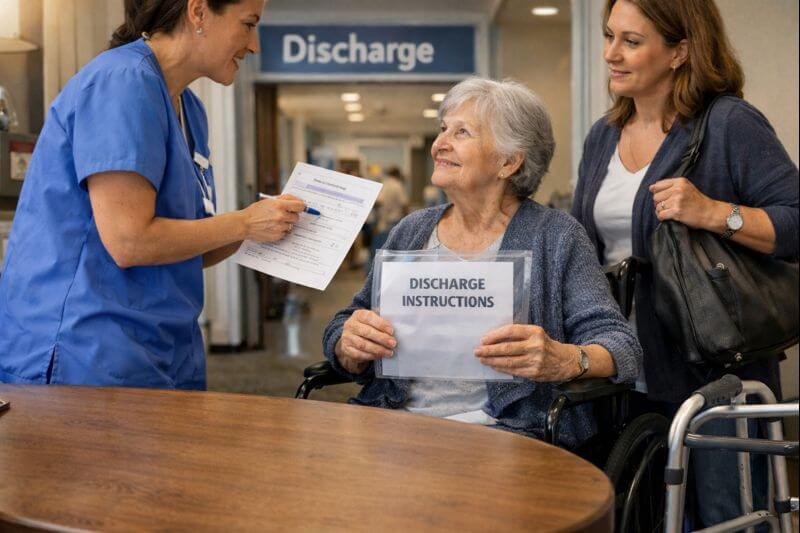
This part is about leaving with something you can actually use at home. If you are already home, use this as a “catch up” list.
- Get the discharge instructions in writing. Ask for the medication list and the follow-up plan in a form you can keep (paper or PDF).
- Make the medication changes plain. Ask, “What was stopped?”, “What is new?”, and “What changed in dose or timing?”
- Write down the contact plan. Who do you call with questions, after hours, and on weekends?
- Confirm what support is supposed to happen next. Equipment, therapy, home care, start dates, and who is arranging what.
Quick move: pick one point person for the first week. That person keeps the plan consistent and updates everyone else.
FIRST 24 HOURS AT HOME: 8 CHECKS
The first day is about reducing confusion. You are not trying to solve everything. You are trying to get the basics stable.
- Put the paperwork in one place. Discharge instructions, medication list, follow-up details, and any new prescriptions.
- Medication list check. Gather everything in the home (pill bottles, blister packs, inhalers, creams). Compare to the discharge medication list. If something does not match, call the pharmacy.
- Set the first 24-hour schedule. Meals, fluids, mobility, rest, and medication timing. Keep it simple and realistic.
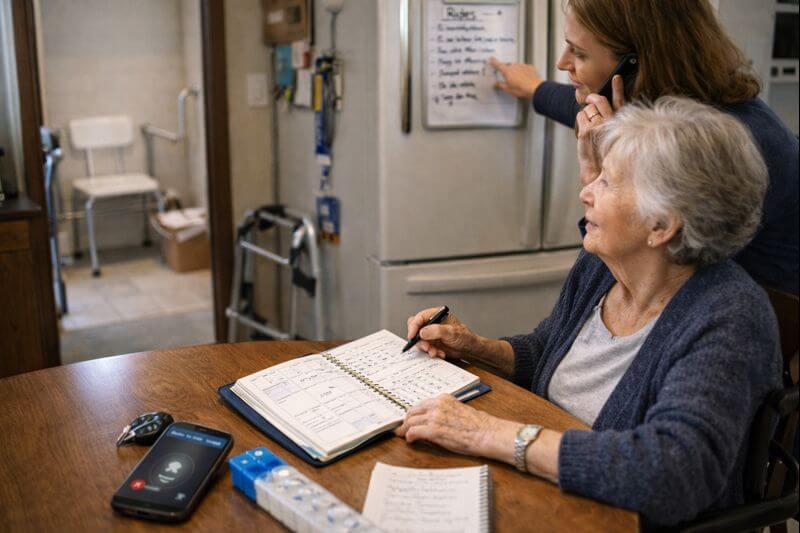
- Write the call list on the fridge. Clinic number, pharmacy number, and Health Link 811. Make sure someone else knows where it is.
- Bathroom setup. Non-slip surface, a stable place to hold, clear path from bed to bathroom, night light.
- Main walkway sweep. Remove loose rugs, cords, clutter. Create one clear route through the home.
- Check mobility on the route they will actually use. Bed to bathroom, bedroom to kitchen, front door to car. Notice what is hard.
- Decide who is “on” tonight. One person owns the first night plan and what to do if symptoms change.

MEDICATION LIST QUESTIONS (PHARMACY-FRIENDLY)
If the medication list after hospital discharge feels confusing, you are not alone. Pharmacies can help, but the questions need to be clear.
- Can you confirm what was stopped? We want to avoid accidentally continuing an old medication.
- What time of day should each one be taken? Morning, noon, evening, bedtime, with food, without.
- What side effects should we watch for in the first week? And what should trigger a call?
- If there is a blister pack, when can it start? If it cannot start right away, what is the short-term plan?
- Are there any interactions we should know about? Supplements, over-the-counter meds, alcohol.
Tip: keep one current medication list and share it with anyone helping. One list, one source.
24 TO 72 HOURS: 9 CONFIRMATIONS
This is the part where the follow-up steps become real. You are confirming what is happening, not just what was discussed.
- Follow-ups booked. Appointments booked, written down, and transportation planned.
- Transportation plan. Who is driving, what time to leave, and what mobility help is needed getting into the car.
- Home supports confirmed. Start date confirmed, who is coming, what help is expected, and what to do if they do not arrive.
- Equipment is usable. Delivered and set up. The walker is adjusted. The shower chair fits. The commode is placed safely.
- Medication timing is working. If timing keeps getting missed, simplify the schedule and ask the pharmacy for help.
- Symptoms are tracked. A short daily note: sleep, appetite, pain, confusion, bowel movements, and mobility.
- Caregiver backup is real. Identify one backup person who can step in for a few hours if needed.
- Work plan. If the caregiver is back at work, decide who is checking in during the day and what that check-in includes.
- Weekend plan. Decide now what you will do if something shifts after hours.
RED FLAGS THAT MEAN “CALL TODAY”
Call your clinician, pharmacy, Health Link 811, or emergency services if needed.
- A fall, near fall, or sudden change in ability to transfer safely
- New or worsening confusion that concerns you
- Medication errors you cannot quickly resolve
- Chest pain, significant breathing concerns, or severe worsening symptoms
- Caregiver cannot safely continue
CALGARY AND ALBERTA NEXT STEPS (IF HOME IS NOT WORKING)
Discharge planning in Alberta is meant to help a person leave hospital safely and understand what supports should happen after. If the current setup is not safe or not sustainable, it is reasonable to ask about more support pathways.
Families often start looking for help when falls risk rises, memory issues are part of the picture, or caregiver capacity is stretched past what is realistic.
If you need a starting point, Health Link 811 can guide you to the right resource. MyHealth.Alberta has discharge planning resources that help you understand what to ask for and what to expect.
CarePatrol of Calgary is a free senior care resource hub. We help families understand level of support, compare realistic options, and coordinate tours and next steps. Families do not pay us.
Talk with a Care Advisor.
ONE-PAGE 72-HOUR CHECKLIST
Copy this into a note or print it. Check each box once it is done.
- ☐Discharge instructions and medication list saved and shared
- ☐Medication list matches what is in the home, or we called to confirm
- ☐Pharmacy questions answered and changes understood
- ☐Follow-up appointments booked, or booking plan written down
- ☐Transportation planned for each follow-up
- ☐Call list written on the fridge (clinic, pharmacy, 811)
- ☐Bathroom is stable, non-slip, and lit at night
- ☐Main walkway is clear and safe
- ☐Equipment is delivered and usable
- ☐Home supports start date confirmed (if applicable)
- ☐Point person and backup helper identified
- ☐We agree on what triggers a call today
SOURCES
- MyHealth.Alberta.ca, My Next Steps: Discharge conversations: View resource
- MyHealth.Alberta.ca, Hospital Discharge Planning: View resource
- Alberta Health Services, Health Link 811: View resource
- CDC STEADI, inpatient care and post-discharge fall risk: View resource
Written by: Shar Gray-Asemota, CPCA® (CarePatrol of Calgary) • Reviewed by: Shar Gray-Asemota, CPCA® (AlignedCare Specialist)
Medical note: Educational only and not medical advice. For diagnosis or treatment, consult your care team. For urgent concerns, call 911.